Turning three years of ambition into practical learning for a more inclusive heritage sector
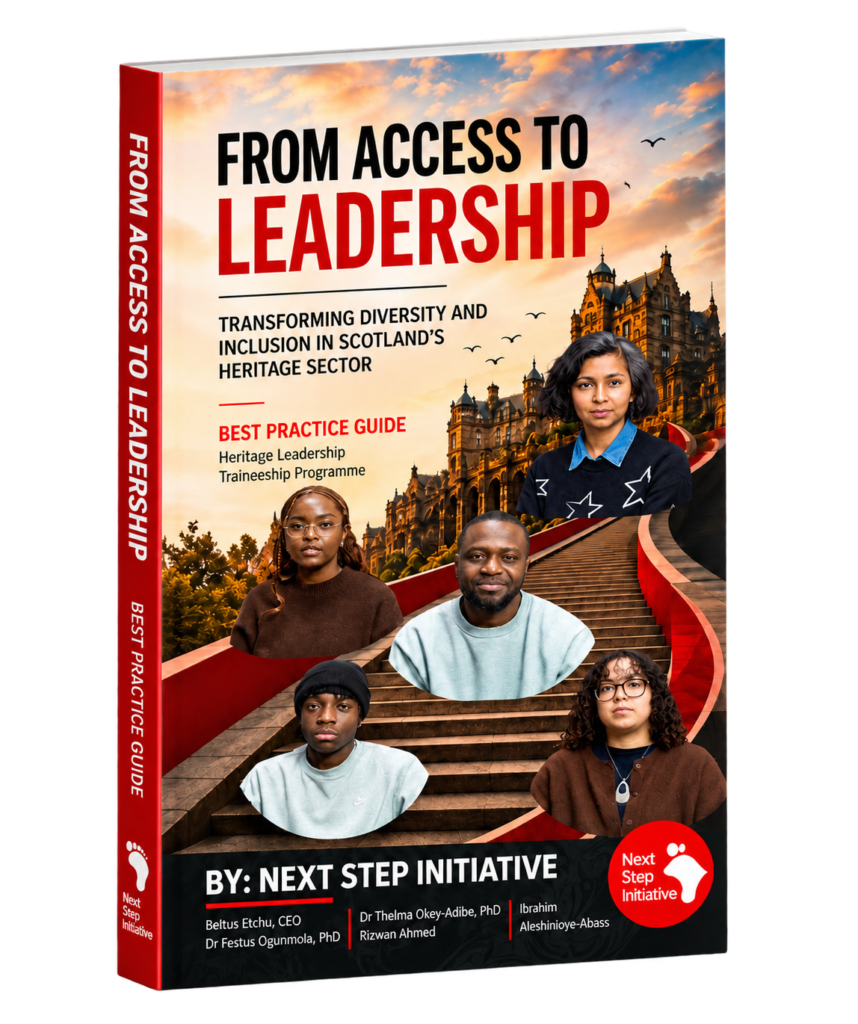
Next Step Initiative is proud to announce the launch of From Access to Leadership: Transforming Diversity and Inclusion in Scotland’s Heritage Sector, a new Best Practice Guide developed from the learning, experience and evidence generated through our Heritage Leadership Traineeship Programme.
The guide will be formally launched as part of Next Step Initiative’s Second Annual Celebration of the Community Heritage Leadership Traineeship Programme, taking place on Wednesday, 14 October 2026 at Calabash Restaurant, Glasgow.
But this publication is more than a record of a programme.
It is an attempt to answer a much bigger question:
How do we move from simply opening the doors of the heritage sector to creating genuine pathways through which people from underrepresented communities can participate, develop, progress and ultimately lead?
That question sits at the heart of From Access to Leadership.
Why This Guide Matters
Scotland’s museums, historic sites, archives and cultural institutions play an important role in shaping how history, identity and belonging are understood.
Yet access to careers and leadership opportunities within the sector has not always reflected the diversity of the communities those institutions serve.
The Heritage Leadership Traineeship Programme was developed in response to some of those structural barriers. It combines paid placements, accredited learning, leadership development, mentoring, community engagement and organisational support, rather than treating workforce diversity as a recruitment exercise alone. Best Practice Guide- Heritage …
The Best Practice Guide brings together the lessons emerging from that work.
Importantly, it does not present inclusion as something achieved simply by placing an individual inside an organisation. The programme’s experience suggests that successful inclusion requires changes on both sides: participants need meaningful opportunities and support, while institutions need the structures, preparation and confidence required to enable people to succeed.
The guide describes this as moving beyond short-term access initiatives towards sustained professional pathways supported by strong organisational infrastructure. Best Practice Guide- Heritage …
Learning From Practice — Including What Needed to Change
One of the most important editorial decisions behind this guide was not to produce a publication that only celebrates success.
Real best practice must include learning.
The programme experienced achievements, but it also encountered challenges around communication, role clarity, alignment between workplace activity and accredited learning, and the capacity of participating organisations. These lessons are openly documented and used to shape recommendations for future delivery. Best Practice Guide- Heritage …
That is significant.
A Best Practice Guide becomes more useful when it explains not only what worked, but also what had to be adjusted and why.
Independent evaluation by Learning Link Scotland found that trainees gained valuable insight into museum operations, became more confident and better prepared for careers within the sector, and benefited from supportive working environments. The evaluation also identified areas requiring stronger communication, clearer expectations and better alignment between practical placements and learning requirements. Best Practice Guide- Heritage …
Those findings have informed the guide rather than being hidden from it.
Seven Principles for More Inclusive Practice
At the centre of From Access to Leadership are seven practical principles drawn from programme delivery.
They are straightforward, but their implications are substantial:
- Co-design with communities, rather than consulting after decisions have already been made.
- Pay participants fairly so that financial circumstances do not become a structural barrier to participation.
- Embed participants in meaningful organisational work rather than peripheral or symbolic projects.
- Support host organisations as actively as the individuals taking part.
- Treat mentoring as essential programme infrastructure, not an optional addition.
- Recognise leadership as something developed through responsibility and experience, rather than something defined purely by job title.
- Invest in relationships, not simply programme outputs.
These principles emerged from experience rather than theory alone. Best Practice Guide- Heritage … Best Practice Guide- Heritage …
Together, they challenge organisations to think differently about what meaningful inclusion actually requires.
From Placement to Organisational Change
The programme has demonstrated that traineeships can create value well beyond the individual trainee.
At the David Livingstone Birthplace Museum, for example, trainees were embedded within core museum operations rather than being restricted to observational or peripheral activities. Their involvement influenced interpretation, programme delivery and community engagement. The museum reported that trainee perspectives encouraged the organisation to look at its work differently and helped strengthen engagement with diverse communities. Best Practice Guide- Heritage …
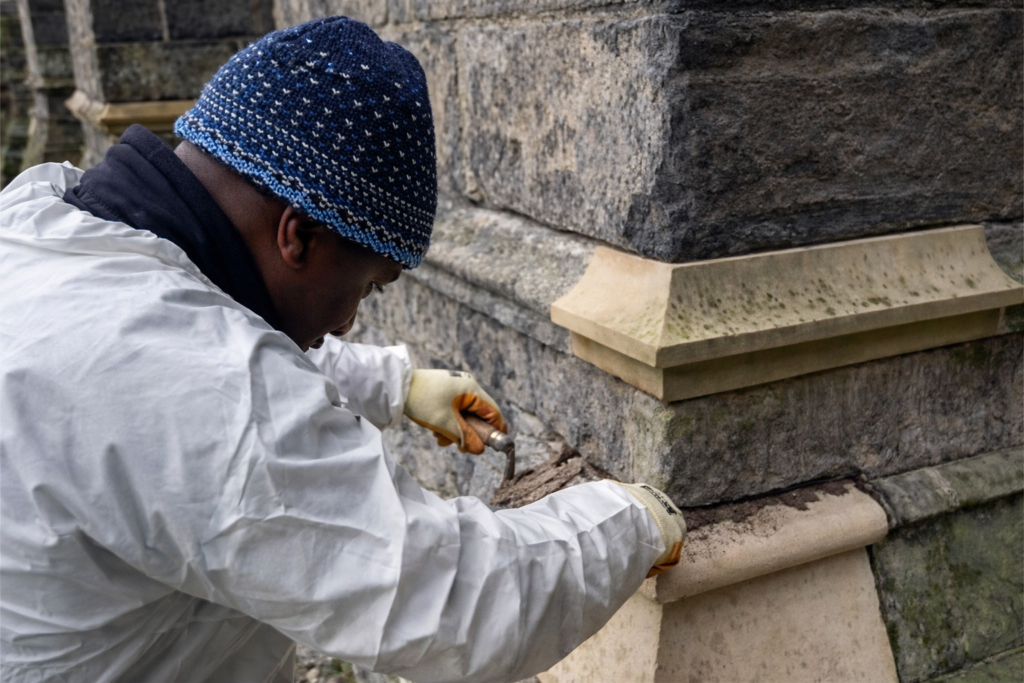
The guide also documents the experience of Joshua Ogunmola at Archaeology Scotland, where practical fieldwork and public engagement enabled him to develop archaeological knowledge, communication skills and confidence in leading learning activities with members of the public. Best Practice Guide- Heritage …
And through the experience of Lababa Naqvi, the guide shows how heritage spaces can become community spaces — connecting storytelling, creativity, wellbeing and inclusive interpretation with the traditional work of museums. Best Practice Guide- Heritage …
These examples reinforce a central argument of the guide:
Meaningful inclusion should change both the participant and the institution.
The Importance of the Intermediary Role
Another important lesson from the programme is the role played by an organisation sitting between trainees, communities, training providers and host institutions.
Next Step Initiative has operated as that coordinating infrastructure — brokering partnerships, supporting trainees, helping organisations manage challenges, connecting accredited learning with workplace experience and providing continuity throughout delivery. Best Practice Guide- Heritage …
This matters because organisations may genuinely want to diversify their workforce but lack the internal capacity, relationships or specialist knowledge required to translate that intention into effective delivery.
The guide therefore argues that successful inclusive workforce programmes cannot depend entirely upon either the resilience of individual trainees or the goodwill of host organisations.
Infrastructure matters.
A Guide Designed to Travel Beyond Heritage
Although the model was developed within Scotland’s heritage sector, one of the most ambitious aspects of the Best Practice Guide is its potential application elsewhere.
A substantial replication toolkit explores how the model could be adapted across sectors including finance and professional services, health and social care, arts and creative industries, local authorities and wider public services. Best Practice Guide- Heritage …
The mechanics may change from sector to sector, but the underlying principles remain consistent: meaningful roles, fair access, structured support, organisational readiness, community connection and leadership development.
The guide therefore represents not only the documentation of one programme, but the beginnings of a transferable workforce-development model.
Building a Heritage Sector Where Everyone Can Lead
In his foreword to the guide, Professor John Struthers observes that:
“Inclusion is not achieved through aspiration alone, but through intentional structures, trusted partnerships, and sustained investment.” Best Practice Guide- Heritage …
That statement captures the central message of From Access to Leadership.
Opening a door matters.
But access is only the beginning.
What happens after someone walks through that door — the quality of their experience, the responsibility they are given, the mentoring they receive, the relationships they build and the opportunities available for progression — ultimately determines whether access becomes genuine inclusion.
And genuine inclusion should create pathways towards leadership.
That is the journey this Best Practice Guide seeks to document.
It is also an invitation to heritage organisations, funders, policymakers, community organisations and leaders across other sectors to consider what can be learned, adapted and improved.
Because the long-term ambition is bigger than one traineeship programme.
It is to help build institutions in which access becomes opportunity, opportunity becomes participation, participation creates development — and development creates the next generation of leaders.
Join Us for the Official Launch
Community Heritage Leadership Traineeship Programme – Second Annual Celebration & Best Practice Guide Launch
Theme: From Access to Leadership
Date: Wednesday, 14 October 2026
Time: 12:00 noon
Venue: Calabash Restaurant, 57 Union Street, Glasgow
The celebration will bring together trainees, heritage organisations, partners, community representatives and stakeholders to recognise the programme’s achievements and officially launch the Heritage Best Practice Guide.
Next Step Initiative
www.nextstepinitiative.org.uk
Ibrahim@nextstepinitiative.org.uk
+44 7426 475 255